Core Equipment & Tile Specifications
All official modern American Mah-jongg games require the following standard equipment, per NMJL rules:
- 152-tile American Mah-jongg set: The modern standard tile count, broken into 5 categories:
- Numbered tiles: 3 suits (Craks/Characters, Dots/Circles, Bams/Bamboo), numbered 1-9, 4 copies per tile (108 total). The 1 Bam is traditionally designed as a bird.
- Wind tiles: 4 types (North, East, West, South), 4 copies each (16 total)
- Dragon tiles: 3 types (Green Dragon, Red Dragon, White Dragon/Soap), 4 copies each (12 total). The White Dragon (nicknamed Soap) doubles as the number 0 in year-themed hands, with fixed suit pairings: Green = Bams, Red = Craks, White = Dots.
- Flower tiles: 8 total, fully interchangeable for all play. Artwork/season variations do not impact gameplay.
- Joker tiles: 8 wild tiles, the defining feature of modern American Mah-jongg, with strict usage rules.
- Current year NMJL rule card: The official annual reference of all valid winning hands, released every April. No official game can be played without the latest card.
- 4 tile racks with pushers: For private tile organization and wall movement.
- 2-6 dice: To determine the wall break position and starting dealer.
NMJL Card Rules (Modern Standard Framework)
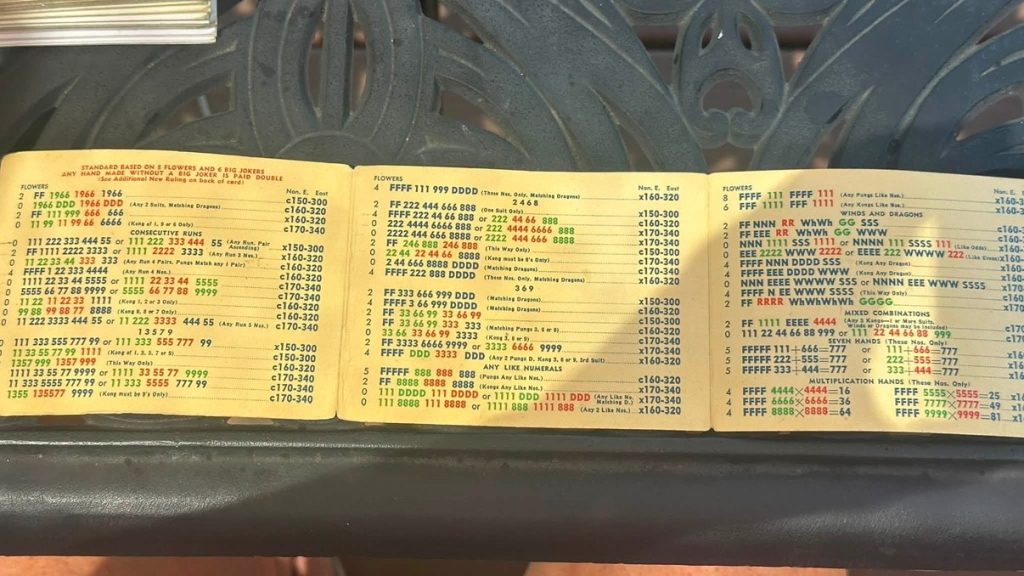
The annual NMJL card is the foundation of modern American Mah-jongg rules, defining every valid 14-tile winning hand. Below is the official framework for reading and interpreting any year’s card.
Standard Abbreviations
- 1-9: Numbered tiles of any suit
- D: Dragon
- F: Flower
- N/E/W/S: North/East/West/South winds
- 0: White Dragon (Soap)
Tile Group Definitions
Each line on the card represents a full winning hand, broken into groups of identical tiles:
- Single: 1 individual tile
- Pair: 2 identical tiles
- Pung: 3 identical tiles
- Kong: 4 identical tiles
- Quint: 5 identical tiles
- Sextet: 6 identical tiles
Critical rule: Sets like
NEWSor year combinations (e.g. 2026) are collections of individual single tiles, not a single meld. This impacts Joker eligibility and calling rules.
Color Coding Rules
Three colors mark tile groups on the card, following two non-negotiable modern rules:
- All tiles marked with the same color must belong to the same suit.
- Tiles marked with different colors must belong to different suits.
- Dragons marked in the same color as numbered tiles must match the corresponding fixed suit pairing.
- Dragons marked in a separate color belong to an independent third suit (called an “opposite dragon”).
Additional Card Markings
- X (Exposed): Hands that allow players to call discarded tiles to build groups.
- C (Concealed): Hands that require all tiles to be drawn from the wall; no intermediate calls are allowed, only the final winning tile may be called. Concealed hands award higher point values.
- Parenthetical notes: Clarify ambiguous rules for specific hands (e.g. “these numbers only”). Notes always override general card conventions.
- Point values: Printed on the right side of each hand, with more difficult hands carrying higher scores.
Full Gameplay Flow & Official Rules
Step 1: Setup & Dealing
- All 4 players sit around a square table, with a tile rack in front of each player.
- Turn all tiles face down and shuffle thoroughly.
- Each player builds a 2-tile-high wall (19 tiles wide, 38 total tiles per player) in front of their rack.
- Push all four walls together to form a closed square in the center of the table.
- All players roll dice; the highest roller becomes the starting dealer (East position).
- East rolls the dice a second time to determine the break point on the wall.
- Deal 4 tiles at a time counterclockwise for 3 rounds, leaving each player with 12 tiles.
- East draws 2 extra tiles (14 total to start), and the remaining 3 players each draw 1 tile (13 total).
Step 2: The Charleston (Mandatory Modern Rule)
The Charleston is a pre-game tile pass exclusive to American Mah-jongg, and a required part of modern NMJL rules. It proceeds in 3 phases:
- First Charleston (Mandatory)
- All players pass 3 unwanted tiles to the player on their right
- All players pass 3 unwanted tiles to the player across from them
- All players pass 3 tiles to the player on their left. For this final pass, players may use 0-3 of their own tiles, supplemented with unviewed tiles received from the right (called a “blind pass”)
- Second Charleston (Optional)
- Only proceeds if all 4 players unanimously agree. The pass order is reversed: left → across → right, with the same blind pass rule for the final round.
- Courtesy Pass
- Each player tells the player opposite them how many tiles (0-3) they wish to pass. Players exchange the lower of the two numbers.
Non-negotiable rule: Jokers may never be passed during any phase of the Charleston. Doing so results in an automatic dead hand.
Step 3: Regular Turn Play
Starting with the dealer (East), every turn follows this exact sequence per modern rules:
- Draw or call: Either draw one tile from the end of the active wall, or call the most recently discarded tile to complete an exposed group.
- Rack and arrange: Add the drawn tile to your private rack, or expose the full completed group on top of your rack if you called a discard.
- Discard: End your turn by discarding one tile face-up to the center of the table, and clearly announce the tile’s name.
Play continues counterclockwise until a player declares Mah Jongg or all wall tiles are exhausted.
Step 4: Mah Jongg (Win) & Wall Game
- To win, call “Mah Jongg!” immediately when you draw or receive the final tile of a valid NMJL card hand.
- Expose your full 14-tile hand for all players to verify against the card.
- If verified as valid, you win the round and collect points per the hand’s printed value. If invalid, your hand is declared dead and play resumes.
- If all tiles are drawn from the wall before any player wins, the round ends in a draw called a “Wall Game”.
Key Special Rules (Calling, Jokers, Dead Hands)
Calling Tile Rules
Per modern NMJL rules, discarded tiles may only be called under the following conditions:
- You can only call the most recently discarded tile, before the next player draws and racks a wall tile.
- Tiles may only be called to complete a group of 3 or more identical tiles (pung, kong, quint), unless the tile completes your final winning hand.
- Discarded Jokers can never be called by any player for any reason.
- Concealed hands may not call tiles for intermediate groups; only the final winning tile may be called.
- Calling priority: If multiple players call the same tile, a Mah Jongg (winning) call always takes highest precedence, followed by the next player in counterclockwise order.
Joker Rules
Jokers are the most powerful tiles in modern American Mah-jongg, with strict standardized limits:
| Allowed Uses | Prohibited Uses |
| Substitute any tile in a pung, kong, or quint (groups of 3+ identical tiles) | Used for singles, pairs, or single-tile sets like NEWS/year hands |
| Swapped for a matching natural tile from any player’s exposed group (on your turn) | Passed during any phase of the Charleston |
| Included in exposed groups when calling a tile | Called from the discard pile |
Dead Hand Rules
A dead hand is disqualified from winning the round. The player continues to draw and discard tiles, but may not make calls or win. Common triggers per modern NMJL rules include:
- Incorrect Mah Jongg declaration (hand does not match the NMJL card, or is a concealed hand with exposures)
- Incorrect exposure (calling a tile that does not form a valid group)
- Passing a Joker during the Charleston
- Holding an incorrect number of tiles at any point in the round
- A hand that is no longer winnable (all required tiles are already exposed or discarded)
- Incorrectly declaring another player’s hand dead (in official tournament play)
5 Common Modern Rule Misconceptions
- Misconception: Jokers can be used for pairsOfficial rule: Jokers may only be used for groups of 3 or more identical tiles. Using a Joker in a pair invalidates your hand.
- Misconception: The Charleston is optionalOfficial rule: The first Charleston round is mandatory in all modern NMJL play. Only the second Charleston requires unanimous player consent.
- Misconception: NEWS is a kong and can use JokersOfficial rule: NEWS is a set of 4 individual single tiles, not a single meld. Jokers may not be used for any part of the set.
- Misconception: All rules change every yearOfficial rule: Core gameplay, tile count, and mechanic rules remain permanent. Only the list of winning hands on the NMJL card is updated annually.
- Misconception: You can call a tile for a concealed handOfficial rule: Concealed hands may only call the final winning tile. No intermediate groups may be called from discards.
FAQs About Modern American Mah-jongg Rules
Q: Do the rules for modern American Mah-jongg change every year?
Core gameplay mechanics, tile specifications, and the Charleston structure stay permanent year to year. Only the valid winning hand combinations on the annual NMJL card are updated each April.
Q: Can I play modern American Mah-jongg with a regular Chinese mahjong set?
No. Standard 144-tile Chinese mahjong sets do not include the 8 Joker tiles required for modern American play. Official sets require 152 total tiles.
Q: What is the difference between modern American Mah-jongg and vintage 1920s versions?
Early American mahjong had inconsistent regional rules, no standardized card, and no formal Charleston process. Modern rules are fully standardized by the NMJL, with mandatory Joker tiles, the Charleston pass, and annual hand updates.
Q: How long does a typical game of modern American Mah-jongg last?
A single round takes 15-30 minutes, depending on player skill level. A full casual game with 4 rounds (one per wind position) usually takes 1-2 hours.
Final Notes
These official rules for modern American Mah-jongg align with current NMJL standards, and apply to all casual home play, local league games, and official tournament play. Mastering these core mechanics is the first step to confident play, league participation, or curating a compliant product lineup for U.S. buyers.