What Is Mahjong and Where Did It Come From?
Learning how to play mahjong is easier than you might think. Mahjong is a tile-based game that originated in China during the mid-to-late Qing Dynasty (1644–1912). Four players sit around a table, each trying to build a winning hand by drawing and discarding tiles — a bit like rummy, but with carved tiles instead of cards. A standard set contains 144 tiles (or 152 in the American version), divided into suits, honors, and bonus tiles.
The game spread to the West in the 1920s when Joseph P. Babcock, an American living in Shanghai, simplified the rules and introduced them to English-speaking audiences. Today, millions of people around the world play mahjong in several major styles — Chinese, American, and Japanese Riichi being the most popular. If you have ever wondered how to play mahjong for dummies, you are in the right place. This guide walks you through everything from tile identification to your first winning hand, so you can learn how to play mahjong quickly and enjoy the game.
Understanding Mahjong Tiles
Before you learn how do you play mahjong, you need to know what the tiles look like. Think of them as three groups: suits, honors, and bonuses. Each group plays a different role in building your winning hand when you play mahjong.
Suit Tiles
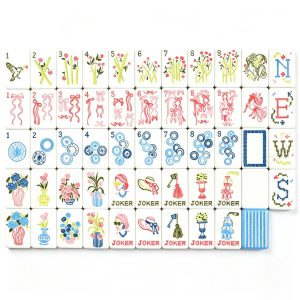
These are the numbered tiles, organized into three suits of 1 through 9. Every number appears four times, giving each suit 36 tiles:
| Suit | Symbols | Copies per Number | Total |
|---|---|---|---|
| Dots (Circles) | Circular patterns | 4 | 36 |
| Bamboo (Bams) | Sticks or birds (1-bam is a bird) | 4 | 36 |
| Characters (Craks) | Chinese numerals | 4 | 36 |
When you first sit down to play mahjong, the suit tiles are what you will work with most. Your goal is to collect matching sets or sequences from these suits. Knowing the suits inside and out is the first step in learning how to play mahjong well.
Honor Tiles
Honor tiles do not have numbers — they represent directions and dragons:
- Winds: East, South, West, North — 4 of each (16 tiles total)
- Dragons: Red, Green, White — 4 of each (12 tiles total)
In Chinese mahjong, wind tiles matter because your seat position (East, South, West, or North) affects scoring. Dragon tiles are used in sets just like suit tiles. Understanding honor tiles is essential when you learn how do you play mahjong in any traditional style.
Bonus Tiles
- Flowers & Seasons: 8 tiles (4 Flowers + 4 Seasons) — used in Chinese and some other variants. If you draw a flower or season, you set it aside and draw a replacement tile.
- Jokers: 8 tiles — unique to American mahjong, they can substitute for any tile in a hand. Jokers make mah jongg play more flexible and forgiving for beginners.
Major Mahjong Variations Compared
When people ask “how to play mah jong” or “how to play mah jongg,” the first thing to figure out is which version they are playing. The three main styles differ in tile count, winning conditions, and scoring complexity.
| Feature | Chinese Mahjong | American Mahjong | Japanese Riichi |
|---|---|---|---|
| Tile Count | 144 | 152 (includes 8 Jokers) | 136 (no flowers) |
| Winning Hands | Standard patterns (4 sets + 1 pair) | Annual NMJL scorecard | Standard patterns + yaku scoring |
| Jokers | No | Yes (8) | No |
| Flowers | Yes (8) | Yes (8, as bonus) | No |
| Scoring | Point-based, complex | Fixed per hand on card | Fu + han system |
| Typical Players | 4 | 4 | 4 |
Data on tile composition sourced from Encyclopædia Britannica — Mah-jongg.
If you are joining a group in the United States, chances are they play American mahjong using the National Mah Jongg League (NMJL) annual card. In Asia and most of the world, Chinese-style rules dominate. Japanese Riichi is its own discipline, popular in arcades and competitive play. No matter which version you choose, the core mahjong play loop remains the same: draw, discard, form sets. The way you learn how to play mah jongg in America is by studying the NMJL card each year.
How to Play Mahjong — Step by Step
Now let’s walk through the core gameplay. Whether you are learning how to play majong in Chinese style or mah jongg play American style, the fundamental loop is the same: draw a tile, then discard one, until someone completes a winning hand. Here is the complete process broken into five clear steps.
Step 1: Set Up the Wall
All tiles are placed face-down and shuffled thoroughly. Each player builds a wall of tiles two tiles high and 18 tiles long (for a 144-tile set) in front of them, forming a square “fortress” in the center of the table. In American mahjong, the wall is typically 19 tiles long per side to accommodate the extra tiles. Setting up the wall is a ritual that every mahjong play session begins with.
Step 2: Deal the Tiles
The dealer (East Wind) rolls two dice to determine where to “break” the wall. Starting from the break point, each player draws 13 tiles in turn — usually in sets of four — until everyone has a hand. The dealer draws a 14th tile to begin play. This is the moment when playing mah jongg truly begins. If you are new and wondering how do you play mah jongg, just remember: 13 tiles in hand, one draw at a time.
Step 3: Draw and Discard
On your turn, follow this simple sequence:
- Draw one tile from the wall (from the next spot in sequence).
- Check your hand — can you form any sets? If not, discard one tile face-up into the center.
- Play continues clockwise (Chinese/Japanese) or according to your group’s house rules.
This draw-and-discard cycle is the heartbeat of every mahjong game. Master this rhythm, and you have mastered how do you play mah jongg at its most basic level. The key to playing mahjong well is knowing when to keep a drawn tile and when to let it go.
Step 4: Claiming Discards
When another player discards a tile, you may claim it to complete a set — but only under certain conditions. Priority matters here:
| Action | What You Need | Priority |
|---|---|---|
| Mahjong (Win) | Complete winning hand | Highest |
| Kong | 4 matching tiles | Second |
| Pung / Pong | 2 matching tiles (to make a set of 3) | Third |
| Chow / Chung | 2 sequential tiles in the same suit (only from the player to your left) | Lowest |
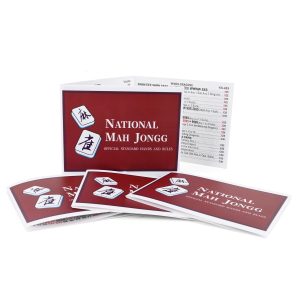
In American mahjong, you cannot claim a discard to form a sequence — only to complete an exposed set (Pung, Kong, or Quint) as shown on the NMJL card. This is one of the key differences when comparing how to play mah jong across styles. Understanding discard claims is a critical part of learning how to play mahjong strategically.
Step 5: Winning the Game
In Chinese mahjong, a standard winning hand consists of 4 sets (melds) + 1 pair, totaling 14 tiles. Sets can be:
- Pung: 3 identical tiles
- Kong: 4 identical tiles (counts as a Pung + 1 extra draw)
- Chow: 3 consecutive tiles of the same suit
In American mahjong, you must match a hand pattern printed on the current year’s NMJL scorecard. The card changes annually, so each season brings fresh challenges. Some hands require specific suits, consecutive numbers, or even all-one-suit combinations. Learning how to play mahjong in the American style means keeping that card handy and studying it between games. The NMJL card is your roadmap for how do you play mahjong when following American rules.
Tips for Beginners Playing Mahjong
Playing mahjong for the first time can feel overwhelming — there are many tiles, rules, and traditions to absorb. Here are practical tips to help you get started with confidence:
- Start with American mahjong if you are in the U.S. — the NMJL card gives you a clear target to aim for, which simplifies decision-making for beginners learning how to play mahjong.
- Learn the tile names first. Being able to quickly identify “3-bam,” “Red Dragon,” or “North Wind” speeds up gameplay dramatically.
- Watch experienced players. Mahjong has a strong oral tradition — much of the strategy is learned by observation, not textbooks. Watching others is one of the best ways to learn mahjong how to play.
- Don’t be afraid to ask. Most mahjong groups are happy to explain a rule mid-game. The game is social by nature.
- Focus on one hand at a time. Beginners often try to chase multiple winning patterns simultaneously. Pick one, commit, and see it through.
- Keep your hand organized. Group tiles by suit and number so you can spot sets quickly.
- Practice regularly. Like any skill game, repetition builds intuition for mahjong play. The more you play, the faster you recognize patterns.
- Play with friends who are also learning. Playing mah jongg with fellow beginners makes the experience less intimidating and more fun for everyone.
Common Mahjong Terms You Should Know
Mahjong has its own vocabulary. Here is a quick-reference glossary for mahjong play that will help you follow along at the table:
| Term | Meaning |
|---|---|
| Wall | The face-down stack of tiles players draw from |
| Hand | The tiles you are holding |
| Discard | Placing a tile face-up in the center |
| Pung / Pong | A set of 3 identical tiles |
| Kong | A set of 4 identical tiles |
| Chow / Chung | A sequence of 3 consecutive tiles in one suit |
| Meld | Any completed set (Pung, Kong, or Chow) |
| Mahjong! | The declaration that you have a winning hand |
| Dead Hand | A hand that can no longer win (too many unmatched tiles) |
| Flowers | Bonus tiles that earn extra points when drawn |
| Quint / Sextet | American mahjong: 5 or 6 of a kind (using Jokers) |
Knowing these terms will make it much easier to follow instructions when someone teaches you how do you play mahjong in person.
Choosing Your First Mahjong Set
If you are learning how to play mah jongg, having a quality set makes the experience far more enjoyable. Here is what to look for when buying your first set for playing mahjong at home:
- Tile count: For American mahjong, get a set with at least 152 tiles (including 8 Jokers). For Chinese style, 144 tiles is standard.
- Material: Acrylic tiles are durable, colorful, and easy to read — ideal for beginners who are learning to play mahjong. Traditional sets use melamine or bamboo-backed materials.
- Size: Standard tiles are about 1.2″ × 0.9″ × 0.6″. Larger tiles are easier on the eyes; smaller tiles are more portable.
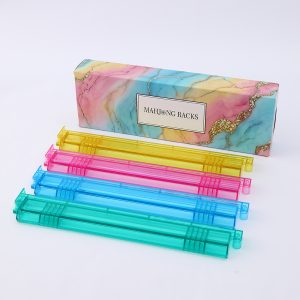
- Accessories: Make sure the set includes dice, wind indicators, and pusher arms or racks (essential for American mahjong).
- Design: Modern sets come in a wide range of colors and patterns — from classic ivory-and-green to pastel and themed designs that make playing mah jongg even more fun.
For players ready to invest in a beautiful, durable set, browse premium mahjong tile sets designed for both casual and competitive play. A good set is an investment that will last years of mahjong play.
Final Thoughts
Learning how to play mahjong for dummies is easier than it looks. The core loop — draw, discard, form sets — is simple. The depth comes from strategy, tile recognition, and reading your opponents. Whether you sit down for a Chinese-style game with friends or join an American mahjong group with the latest NMJL card, the best way to learn mahjong how to play is to simply start. Grab a set, find a table, and let the tiles teach you.
Remember, every expert was once a beginner. The more you practice mahjong play, the more natural it becomes. Soon you will be calling “Mahjong!” with confidence. And once you know how to play mahjong, you will discover a game that rewards patience, strategy, and a little bit of luck — a perfect way to spend an evening with friends.
Mahjong sets & accessories from this guide
Mahjongg Cards
$3.50
Prices are in USD. SO MAHJ ships from our own workshop; see each product page for shipping and returns.